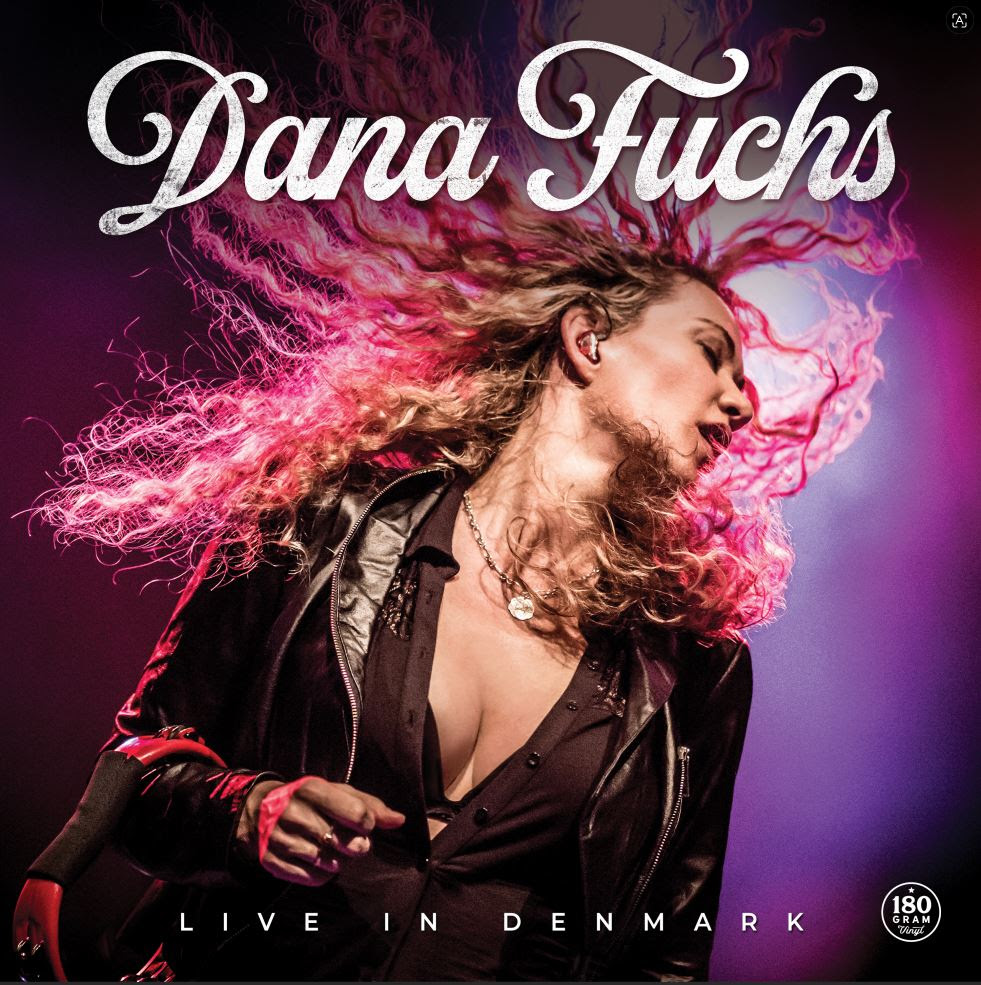
Dana Fuchs is a unique talent, singer, songwriter, and actress. Her powerful voice and emotional songs are on full display on her new record Live In Denmark. Dana recently took some time to talk about the record and her amazing career in and out of music!
Please press the PLAY icon below for the MisplacedStraws Dana Fuchs interview –
On her backing band for the album – On guitar is always the same person, my music partner, co-writer, and we founded this project together many years ago, Jon Diamond from New York City. My now bass player, who’s been in the band for the last several years, since the pandemic really, because we live together, my husband, Kevin McCall, Yeah And my longtime European drummer from Lucca, Italy, Piero Pirelli.
On if she was happy with the results of playing live without a keyboardist – Surprisingly, yes. I love the keyboard players I’ve worked with. It takes nothing away from them. But I realize, there was a period where I felt like, “oh, if I don’t have keys, it’s not gonna sound as good”. You get nervous, and you feel like the audience will miss that extra piece. I miss that extra piece. I found there was this whole other level of freedom. I was also able to really own the story of the songs a little more. Because, it’s so tempting when you have a great keyboard player, which I’ve always had, you just wanna throw them solos and stand up there and jam and close my eyes. So, it was really a different experience to just really get inside the songs lyrically and to hear my voice so much without that beautiful organ padding. So yeah, I was.
On her voice taking center stage without keys – Yeah, and I think I was afraid of that. Years ago, when I did the first few live albums I did I didn’t wanna be that forward. With age comes a little more confidence.
On what allows her to reach a level live that can’t be reached in the studio – That’s such a great question, and I have to just respond first, so many years it was frustrating because people would be like, “I like your album, but I like you so much better live.” I never knew how to take that. But I finally understand now what they meant because it’s also what I feel, especially with this last album, because it really does represent me live. I think it’s because, when you’re on stage, you’re not confined. Anything goes, and it’s like you have to get up there knowing, “I might not be perfect tonight. I’m gonna let it all out”. My mood, the mood of the audience, we’re gonna meet each other in this place that is not predetermined.
When you’re going in the studio, it’s a little different because you’re following, sometimes drummers use a click. You’re following a set arrangement. Live, I just love to throw all that out the window. Studio has a whole other wonderful world to it that I love that live doesn’t, but when you’re up there live, it’s so visceral. For me especially, I feel like I’m cheating a little because it’s like I really need to connect with the audience so I’m not nervous. I’m nervous if I don’t feel that connection, so I do whatever I can when the show starts to make sure we’re somehow connected. Even if I have to get on my knees and in their face if they’re sitting close to the stage or go give somebody a hug that I haven’t seen in a while, I really need that. You can’t do that in the studio, obviously. So, I feed off of the live energy of the audience, not just the band.
On the emotional journey she goes on during a live performance – It’s really, again, so much part of that connection with the audience and my band, they finally understand, I’ll give you an idea of some of the songs I wanna do tonight, but we won’t have a set list. I’ll pivot in a moment on stage just going “I think this one’s gonna land,” or on a little differently, “I think this is what I’m in the mood to sing.” So, I think being live, I can just follow a mood, a vibe, a feeling, a hunch. Every song is so personal, but I love what you just said because my goal has always been when I write a song, not for it to be about me, but to open up an experience I’ve had and say, “Hey, can you relate in any way, too? We are having this shared experience together.” And so that’s quite a high compliment. I appreciate that.
On if she was nervous about how this record would come out – Yes. Especially this live album was the first one where we didn’t do it in New York. So we knew, this is it. We’ve got one night. You’re gonna get what you get. I honestly didn’t wanna listen back at first, because I’ve always been my own worst critic for live performances, and knowing that there was no way to fix anything I didn’t like or change anything I didn’t like. I kept telling my manager, I was like, “No, I’ll trust you if it sucks,” “No, I really think you should listen. I think you’ll be happy.” No.” But finally he said, “Sit down and listen.” I put the headphones on and I was like, “Okay. I like that one.” Then I went to the next one, “Oh, shit okay.” It was quite a relief. I got a little emotional because, you sometimes, you don’t know. You get in a vacuum and go, “Do I suck?” Then I heard it back and I was like, “Dang, that was pretty good.”
On if she ever expected a song to hit live but it didn’t work – Oh, yes. Many times. I remember someone saying to me when I first started out, this very wise musician was like- When you think you’ve had your best night, the audience doesn’t usually agree. When you think you’ve had your worst night is when the audience thinks it was your best. Don’t get hung up on that, you can’t go in with preconceived notions, and I learned that really early on. I think doing the “Love Janis” show, it was really interesting for me because it was so much easier to go play her, because I didn’t feel on the hook for me. I remember, because I was still new at it, I wasn’t touring really much yet. I was doing a regular residency in the Village. I’d done all the blues clubs in New York. So, I was a regular staple in New York City and a few shows in Finland, but not a lot in between. I remember just learning at one point throughout that show why it was so much easier for me to do Janis than me, because I had to do reckless abandon. I had to fake reckless abandon as Janis Joplin or pretend to be her, in a sense. And then I was like, wait, I need to give myself permission to not care about how I look, how perfect or imperfect I am. I’ve had clothes fall off of me, zippers go down, spit flies out of my mouth. I’ve fallen on stage more than once and not from drinking, I’m a klutz. I think once you get to that point, I tell younger artists that a lot when they wanna ask for some guidance. I just say, “As soon as you’re trying to be cool, you are so uncool. As soon as you don’t give a damn about being cool or being perfect, you’re the coolest person in the room because everybody can relate.” Nobody wants to see perfect. Maybe some people do. Not my audience, not me.
On building a career in Scandinavia – I don’t wanna sound at all dark about my home country, because I love my home country, but there is a support and a funding for the arts that makes it more accessible to people over there. They’ve been able to just really book me and were able to take a chance on me before, without me having a hit on the radio. I was able to make a real living over there, and then once you’ve gone over several times, if you develop a connection with your audience, you have very loyal audience.
So. with a loyal audience and, everybody feeling “okay, we can go over for weeks at a time”, it just sets it up that way. The States is a little harder. It’s longer drives, it’s further out there. But I think the audiences themselves are just music lovers, and they’re the same. It’s just I don’t get to reach them as easily as I can, okay, you’re on the road, you’re on tour, you’re gonna have a show every night for the next several weeks. Here you are. That’s a little harder to pull off in the States, but the people are the same. They really are. They’re, music lovers are music lovers, and they are such fun audiences. I don’t have a preference of audience at all.
On becoming a teacher – It’s been quite a journey. When the pandemic hit, I realized, “Okay, I’m not gonna sit around and twiddle my thumbs.” I had already had an interest in working with kids. I was doing it organically anyway, and then the pandemic, my son, my oldest son, was three and a half, and I was about to have another child, and I really wanted him to not be isolated and to give him a social experience. So, I started a little pandemic pod and realized I really loved being around kids and seeing the world through their eyes. I already knew that with my son, because he went on every tour with me since he was four weeks old. I would go out for two months at a time, and logistically it was much harder, but it was so much more fun not sitting around a backstage waiting for the band to set up. In Germany, I’d find the nearest playground or the nearest park, so it was a whole new world. Then as he got older and started to develop some friends in the neighborhood, and I started this pod, I just loved it, and we would do music stuff, performing arts kind of stuff.
Then summer was approaching. People were asking, “Would you run a summer camp?” So, I thought, “Yeah, why not?” So, I started this summer camp. Had 9 to 12 kids a day. Now it’s up to 27 in the summer, and I can leave and go on tour and have great people running it for me. I really feel like I’ve gotten the best of both worlds. I went back to grad school, graduate school, just really to look better on paper and to learn a little bit more about what I was doing because I had the downtime with the pandemic, so I got a scholarship thanks to Julie Taymor wrote me this beautiful letter of recommendation, and that was it.
On her work with the Jed Foundation – Yeah, the Jed Foundation. It’s gone through so many iterations since I met the CEO, John McPhee, years ago, who had unbeknownst to me been at a show of mine and heard me dedicating a song to my late sister who died by suicide. Maybe a year or so later, I had just moved to Harlem, this is now almost 13 years ago, and this guy calls me over to his table, and he’s the guy that’s with the Jed Foundation. “I heard the story of your sister. I work for this foundation. Would you be willing to come in and talk to us about being an ambassador?”
Long story short I just saw what they were doing. So, Jed is based, it’s the name of a young man who died by suicide in college at Stanford University, and his parents were just shocked. They didn’t see any warning signs. He was a good student, a popular kid, seemed happy enough, right? And when they spoke to the dean of that school, they said, “Did you see any signs?” The dean said, “With all due respect, thousands of kids come in through these doors every day. We can’t monitor that.” So that gave his parents the idea to develop an organization that would go in, initially it was colleges, and set up this infrastructure where, you had people that could respond, friends of friends.
It was just assistant, a lot of volunteer students, and Jed workers guiding them. Now it’s gone into high schools and, my bass player and husband, Kevin McCall, became one of their chief branding officers, because he had some experience in mental health work. So, he created for them this thing called Jed Voices, which just really took off, and Kevin had been with MTV for many years, so his expertise was taking celebrities and getting them comfortable talking about themselves or doing promo campaigns. So. now he’s doing it in the mental health arena with some pretty big names, and it was really interesting to see it grow and evolve and become what it is now, and it’s helping more people, just more and more resources. I believe they just partnered up with the American Foundation of Suicide Prevention.
My job for Jed is just a volunteer position. Wherever I’m on stage, I talk about, hey, there’s no shame in depression and addiction. We have to talk to each other. We have to take the stigma and the taboo away from it all. Then we’ll have less of those tragic life stories, end of life stories, I should say.
On upcoming touring – So after Europe is Canada, and then we have a show coming up at the Lizzie Rose in June. I think it’s the 27th of June. We play there usually every spring. It’s a wonderful little room. We are playing Blast Furnace Festival in Pennsylvania in July. Then we’re talking to Ruff Records now about another recording, possibly in the fall so we can do another spring tour US- and Europe. We gotta just see when the timing aligns for getting in the studio and juggling all the variables, which is always the hard part.
On if she’s begun writing for the next record – My guitarist always has snippets of music ideas that he’ll just keep saving and saving, and then he’ll say, “You gotta hear this. You gotta hear this,” and he’ll text it to me, and then if I don’t get right back, “Please just listen.” Then when I finally sit and listen, if it’s something that grabs me, I’m like, “Whoa.” Then I’ll just start putting some words to it. Other times, usually I like to run, and I live near Central Park, so I take long runs, and that’s when I always get song ideas. Then I just have to take my phone voice memo out and talk my lyrics into it. But yeah, I think we’re always writing, not maybe a fully fleshed song until the deadline is there, it’s “okay we got an album to write. We better get to it.” Then all these ideas come up back to the surface.
